A while ago, I wrote about the architect Thomas Johnson and how he had been involved in the restoration of the church of St Michael on Greenhill in 1842/3. In the newspaper archive, I found a report of a meeting of parishioners held at the church, prior to these restoration works.

The article is a bit blurry and hard to read but after much squinting it seems that there was concern that the church was at risk of ‘being reduced to ruins’ and that the churchwardens had appointed Mr Johnson to assess the extent of the dilapidations. His diagnosis was that the roof, ceiling, spire and a portion of the walls were so unsafe that a large sum of money would be needed to keep up the building. The parishioners expressed their surprise at how bad the situation was. To illustrate just how bad things had got, it was revealed that rabbits had managed to get into the mausoleum of the Marquis of Donegal (he of Fisherwick) and were breeding in the coffins. The outcome was that the land owning parishioners agreed to increase their rates to pay for the necessary work which according to the County History included
“the reroofing of the nave, the repair of the side aisles and the nave clerestory, the reintroduction of Perpendicular windows in the north aisle, the rebuilding of the north porch, and the remodelling of the south aisle with new buttresses and a south door in place of a window. The gallery was removed. The mausoleum and the vestry room were replaced by a stokehold over which a clergy vestry was built with doors into the chancel and the south aisle; an organ loft was built over the vestry”.

St Michael’s above Stowe Pool
I have never been into the church myself. However, I notice via facebook that the church will be open for viewing tomorrow (between 3pm & 5.30pm) during the launch of the Bell Restoration Fund. You can find out more on their facebook page here and you can read the great article Annette Rubery wrote about the fund here.
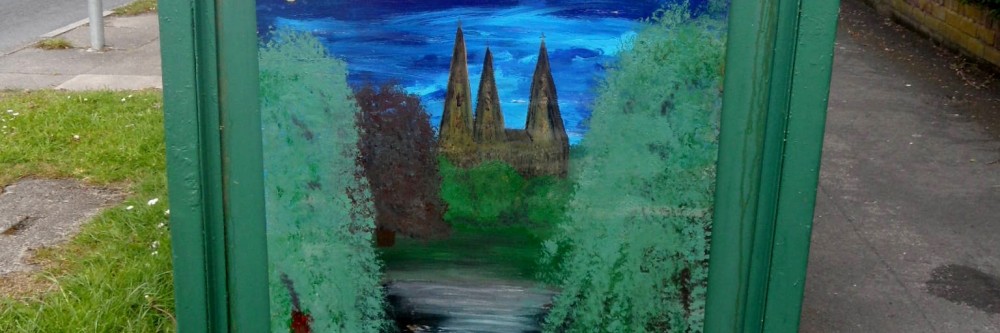
The church is of course featured on the ward banner for this part of Lichfield (along with what I had assumed was the Greenhill Bower House, although looking at it again now I’m not so sure…)

Although I’ve never been inside the church, I have been to the churchyard. With claims on Wikipedia that it could be a Mercian tribal necropolis, the site of one of the earliest settlements in Lichfield or the burial place of followers of St Amphibalus, it certainly merits a post of its own one day!

Steps leading up to the churchyard
Edit: I’ve just been thinking about the building on the ward flag, below the church. Could it in fact be the gateway to the old Lichfield Union Workhouse (subsequently St Michael’s Hospital).
Sources:
Lichfield Mercury Archive
Lichfield: Churches’, A History of the County of Stafford: Volume 14: Lichfield (1990), pp. 134-155
 Lichfield Lore
I love the idea of rabbits burrowing in the coffins! Not very conducive to worship though, I suppose. Are you going to visit and take some photos for us?
LikeLike
Yes I went and took some photos! I’m just writing a post about yesterday. You may be interested to know that the Donegal museum saga continues…. 😉
LikeLike
I too like the idea of rabbits living in the coffins. It takes away the dark side.
Don’t forget – if you want any links put to tree following posts – do, let me know.
Lucy
LikeLike
Thanks Lucy. I need to do some tree following. I think ‘summer’ isn’t as interesting as Spring & Autumn so I’ve not been as attentive!
LikeLike
Pingback: Appeal of Bells | Lichfield Lore
Re: https://lichfieldlore.co.uk/tag/church-2/ & daisy wheels. The ‘day’s eye’ aspect of the daisy is of course the sun. The six petalled carved daisy wheel is in the form of the Madonna Lily and was originally a reference to the Virgin Mary who was strongly associated with this flower before the Reformation swept her cult from Britain.
http://www.whats-your-sign.com/lily-meaning.html
LikeLike